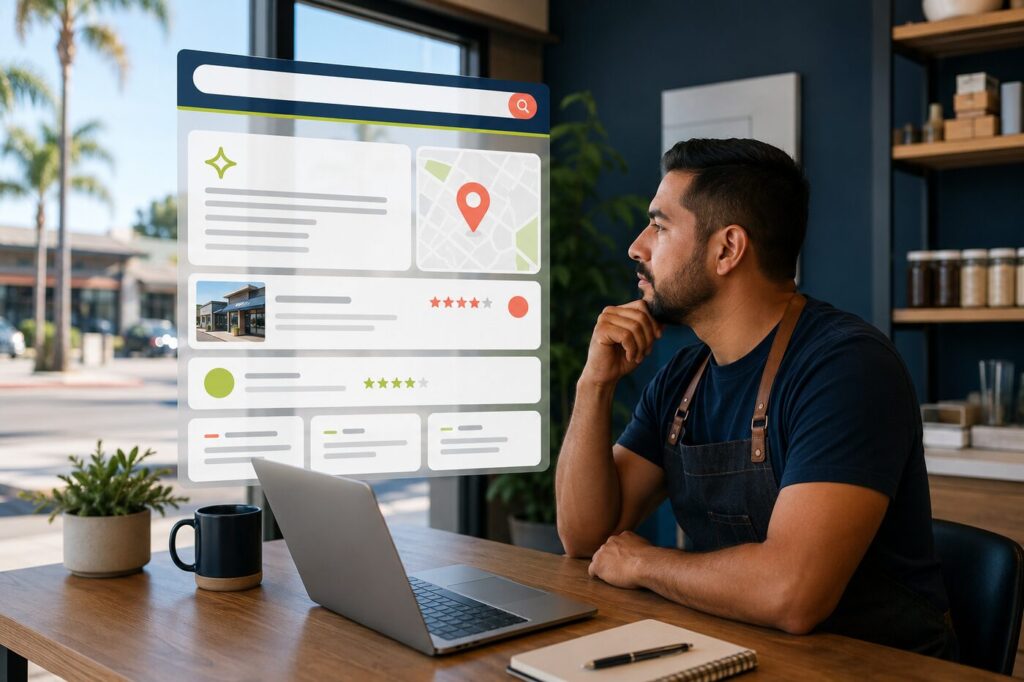
AI search is changing SEO for local businesses because the search result is increasingly becoming an answer, not only a list of links. A customer can ask a detailed question, compare options, refine the request and receive a summarized response before visiting a website.
This does not make local SEO irrelevant. It raises the standard. Search systems still need reliable information about the business, its services, location, reputation and expertise. The businesses most likely to remain visible are those that make these facts easy to find, verify and connect.
What has changed in AI search?
Google reported in May 2026 that AI Mode had surpassed one billion monthly users, while AI Mode queries were more than doubling each quarter. Google also says people are asking new kinds of questions through generative search features. This means local discovery is expanding beyond short queries such as “plumber near me” or “phone repair Chula Vista.”
A customer may now ask:
- Which local repair shop can fix a Samsung screen today and offers a warranty?
- What is the best accountant near Eastlake for a new ecommerce company?
- Which Chula Vista restaurant is suitable for a family group with dietary restrictions?
These queries contain several conditions. AI search tries to combine information from business profiles, websites, reviews, directories and other sources into one response.
Traditional local SEO versus AI search visibility
| Area | Traditional local SEO | AI search requirement |
|---|---|---|
| Business information | Consistent name, address and phone | Consistent entities, services, areas and attributes |
| Website content | Service and location keywords | Clear answers, supporting details and verifiable claims |
| Reviews | Quantity, rating and recency | Specific customer evidence about services and outcomes |
| Authority | Backlinks and citations | Independent mentions that confirm expertise and relevance |
| Conversion | Clicks, calls and directions | Visibility both with and without an immediate website click |
1. Your business entity must be consistent
Search engines need to understand that the website, Google Business Profile, directory listings and independent mentions refer to the same business. Keep the business name, primary address, phone number, website and service categories consistent.
Consistency also applies to descriptive facts. If one page says the business serves only Chula Vista while another claims coverage across all San Diego County, the relationship becomes less clear. Define the actual service area and use the same language across important profiles.
2. Service pages need complete answers
A thin service page built around one keyword gives an AI system little material to work with. A strong page explains the service, who it is for, common problems, process, location, availability, limitations, pricing factors and frequently asked questions.
Do not fill the page with repeated location names. Add information that helps someone make a decision. For example, a phone repair page can explain supported devices, part options, expected turnaround, warranty terms and data handling.
3. Reviews should provide specific evidence
A five-star rating is useful, but the text inside reviews can provide stronger context. Reviews that mention the actual service, neighborhood, speed, communication or result help search systems and customers understand what the business is known for.
Do not tell customers what to write. Ask for honest feedback about the service they received. Respond professionally, especially when the review identifies a real problem.
4. Independent citations still matter
AI answers often rely on multiple sources. A business that describes itself as the best option has made a claim. A local publication, chamber directory, professional association or relevant industry source can provide independent confirmation.
Prioritize accurate and relevant mentions. Fifty low-quality directories with copied descriptions are less useful than a smaller set of trusted sources that clearly identify the business.
5. Structured data can reduce ambiguity
LocalBusiness schema can help define the organization, address, telephone number, opening hours, service area and related profiles. Service, Article, Breadcrumb and FAQ structured data may also help search systems interpret page relationships when used accurately.
Schema does not create authority by itself. It should describe information that is already visible and truthful on the page.
6. Original local knowledge creates differentiation
Generic content can be reproduced by almost any competitor. Local knowledge is harder to copy. Useful examples include neighborhood-specific service considerations, local regulations, seasonal demand, parking details, response areas and questions customers commonly ask in Chula Vista.
This is where human experience matters. AI can help organize the page, but the business should supply the facts that only a real local operator knows.
7. Brand demand becomes more important
If customers search for the business by name, mention it in relevant communities and return directly to the website, the brand has built demand beyond one keyword. That strengthens resilience when search layouts change.
Use local partnerships, useful resources, email, social profiles and consistent customer experience to build recognition. SEO should support the brand, not act as its only source of visibility.
A 90-day AI search SEO plan for a local business
Days 1 to 30: establish accurate facts
- Audit the business name, address, phone, hours and primary categories.
- Correct major profiles and duplicate listings.
- Confirm indexability, mobile usability and basic technical health.
- Define services, service areas and real differentiators.
Days 31 to 60: improve decision-making content
- Expand priority service pages around customer questions.
- Add proof, process details, qualifications and clear limitations.
- Create a useful About page and editorial or review standards where relevant.
- Add accurate structured data.
Days 61 to 90: build external confirmation
- Earn relevant local citations and partnerships.
- Request honest customer reviews consistently.
- Publish original local resources worth citing.
- Track brand mentions and AI-search appearances manually.
How to measure AI search visibility
There is no single complete report for every AI answer surface. Use a combined measurement model:
- Track important prompts across major search and answer platforms.
- Record whether the business appears, how it is described and which sources are cited.
- Monitor branded searches, direct traffic, calls, forms and assisted conversions.
- Watch Google Business Profile actions and review growth.
- Use Search Console to evaluate queries and landing pages, not only total clicks.
Google’s official update on the new era of AI Search confirms that user behavior is changing quickly. Local businesses should respond by improving facts, proof and usefulness, rather than chasing a separate set of tricks for every platform.
Frequently asked questions
Does AI search replace Google Business Profile?
No. Accurate business-profile data remains a major source of local facts, actions and customer evidence. AI search increases the need to keep that information consistent with the website.
Do local businesses still need backlinks?
Yes, but relevance and trust matter more than volume. Independent links and mentions can help confirm that a business is established and connected to its topic or location.
Should local businesses publish AI-generated content?
AI can support research and drafting, but the final page should contain verified facts, local experience and human review. Publishing generic volume without a clear purpose can create more weak pages to maintain.
For a local example, read our guide to the top mobile phone repair shops in Chula Vista, then browse more SEO coverage.
About this article
Techy Chula Vista reviews material claims and updates published coverage when important facts change. Read our editorial policy.